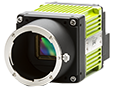
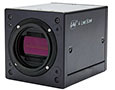
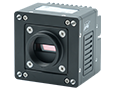
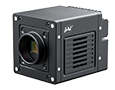
JAI’s extensive product offering includes color line scan cameras featuring bilinear, trilinear or prism technology with CCD, CMOS or InGaAs linear sensors delivering high performance color, color+NIR and color+SWIR imaging solutions for high-speed web/continuous applications such as print verification, tile inspection, food/fruit sorting, and more. Also monochrome line scan cameras with ultra fast scan rates are in the product range.
Single-Sensor Monochrome
Monochrome CMOS sensor line scan cameras with an excellent combination of high resolution and fast scan rates. Resolutions up to 8192 pixels and line rates up to 200 kHz.
Single-Sensor SWIR
SWIR line scan cameras featuring advanced InGaAs sensors for reliable material differentiation and inspection beyond the visible spectrum.
Trilinear & bilinear color
Trilinear and bilinear cameras delivering line scan color images for applications that don't require the ultimate color precision provided by JAI’s prism line scan cameras.
3-Sensor R-G-B (Prism)
3-sensor CMOS R-G-B color line scan cameras with state-of-the-art prism technology providing the best possible performance, precision, and versatility for line scan color imaging.
4-Sensor R-G-B+NIR (Prism)
4-sensor line scan cameras designed to simultaneously capture R-G-B image data in the visible light spectrum and image data in the near infrared (NIR) light spectrum.
4-Sensor R-G-B+SWIR (Prism)
4-sensor line scan cameras designed to simultaneously capture R-G-B image data in the visible light spectrum and image data in the short wave infrared (SWIR) light spectrum.
2-Sensor SWIR+SWIR (Prism)
Prism based dual-sensor InGaAs line scan camera for Short Wave InfraRed (SWIR) light.
A line scan camera is an industrial imaging device that captures images one line of pixels at a time instead of acquiring a full frame in a single exposure. A line scan camera uses a single line of pixel data to build up a two-dimensional image, which allows detection of small defects at high speed.
A line scan camera is ideal for continuous inspection and high-speed industrial imaging applications, including web inspection, conveyor-based inspection, semiconductor inspection, electronics inspection, and surface inspection. It is widely used for paper, plastic film, and metal sheet inspection, as well as food sorting, wafer inspection, PCB inspection, and print defect detection. Line scan cameras also excel at identifying coating irregularities and surface flaws and are well suited for high-resolution imaging of large objects such as wood panels and solar panels.
The line scan camera continuously captures individual lines of pixel data, which can either be analyzed in real time as they are acquired or reconstructed by software into a complete 2D image for further processing.
To form this full image, relative motion between the camera and the object is required. This is typically achieved by moving products on a conveyor belt or rotating them on a stage. As the object passes the sensor, the camera records sequential lines that are combined to create a two-dimensional image.
Color line scan cameras create full-color images by capturing separate red, green, and blue channel data using one of three technologies: bilinear, trilinear, or prism-based designs.Bilinear and trilinear cameras use color filters directly on the sensor lines to capture RGB information. Bilinear models use two lines and reconstruct color through interpolation, while trilinear models use three dedicated lines (R, G, and B) that are digitally aligned as the object moves.Prism-based cameras, in contrast, use a beam-splitting prism to optically separate incoming light into red, green, and blue components before directing them to three aligned sensors. This enables simultaneous color capture at the same spatial position and delivers the highest color accuracy.
Line scan cameras are most effective when you need to inspect long, continuous items, or a variety of items that have many different lengths or sizes. When the object does not have a well-defined start, end, or even size to it, a line scan camera is most suitable for your application. Because they operate continuously, line scan cameras have a vertical resolution that is effectively “unlimited” and can easily construct two dimensional images with much greater total resolution.
An area scan camera, on the other hand, is typically used when the items that are being inspected, sorted, or analyzed have definite shapes or boundaries.
For a more detailed explanation and side-by-side examples, see our line scan vs. area scan camera comparison.
From the earliest line scan imaging systems to today’s high-speed, high-resolution cameras, a lot has changed. Discover the key milestones and technologies that shaped the evolution of line scan imaging.
Bank note inspection
Bank notes are usually produced across several production sites. They must be of high quality to be retailed and trusted, as well as include complex security features to be counterfeit proof. A robust and highly sensitive control system that supports a wide range of features, as well as ensuring high quality and compliance across all production sites is needed.
Photometric Stereo Vision at Breakneck Speed
The photometric stereo method uses multiple images of the same object or scene captured under different lighting directions. In the individual images, the surface shape creates characteristic brightness variations, often simplified as “shadows.”
Improving food safety and quality in fruit sorting and grading
Fruit and vegetable sorting has evolved far beyond surface-level inspection. As food safety regulations tighten and quality expectations rise, producers need inspection technologies that can detect internal defects, subtle material differences, and hidden contamination at full production speed.
Improve Free-Fall Food Sorting
Free-fall optical food sorting presents a unique set of challenges. Products move at varying speeds, rotate unpredictably, and must be inspected in milliseconds - all while maintaining the highest standards of quality and food safety.
Key Inspection Stages in Lithium-Ion Battery Manufacturing
Lithium-ion batteries have become the backbone of modern energy storage, powering everything from consumer electronics to electric vehicles and large-scale grid systems. As production scales and performance expectations rise, ensuring the safety, consistency, and reliability of each cell has never been more crucial.
Choosing the right line scan camera depends on the specific requirements of your application. Key factors include line rate, interface, sensor type, and the speed of the inspected object.
To achieve optimal performance, the camera interface should align with your throughput needs. GigE Vision enables flexible system design and easy integration, while Camera Link and CoaXPress are ideal for high-speed data acquisition in demanding environments. USB Vision provides a practical option for compact or cost-sensitive systems.
Choosing the right sensor technology is equally important, especially for applications that require monochrome or color imaging, enhanced sensitivity, or imaging beyond the visible spectrum.Find your ideal line scan camera using our camera selection guide.
Need help – let us help you to find the perfect line scan camera
Our camera experts are here to assist you so you can take full advantage by pairing the right JAI camera with the right lens.