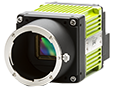
When sorting cotton, tobacco, and broccoli, it’s often difficult for the human eye or conventional cameras to reliably detect foreign materials with similar colors, identify minor quality differences, or keep up with high-speed production lines. Here, we share three real-world cases showing how prism cameras tackle these challenges with advanced technology.
JAI's unique prism-based color separation technology accurately splits incoming light into red, green, and blue wavelengths. Each color is then captured by a dedicated sensor. This approach is especially useful when objects have uneven surfaces or production lines run at inconsistent speeds. Compared to traditional Bayer cameras, it prevents color blending and moiré patterns, delivering better color accuracy and sharper image detail.
Cotton Impurity Removal: How to Detect “Invisible” Foreign Materials at High Speed?The Challenge:A cotton cleaning equipment manufacturer in Xinjiang needed to reliably detect impurities such as irrigation tape, plastic film, and hair mixed into cotton. These foreign materials either closely match the color of cotton fibers or are extremely fine and lightweight, making them nearly “invisible” on production lines running at 4.5 meters per second.
JAI Prism-Based High-Speed Line Scan Camera Solution:Sweep+ Series LT-400CL Prism True-Color Line Scan Camera
The unique prism-based color separation technology precisely splits light into independent red, green, and blue channels for imaging. Even if irrigation tape, plastic film, or foreign fibers closely match the color of cotton, the system can accurately distinguish them, enabling stable and reliable detection of impurities.
The prism camera achieves a scanning speed of up to 16,180 lines per second, with each line providing 3×4096 pixel resolution while maintaining a signal-to-noise ratio of at least 55dB. This ensures clear visibility of every cotton fiber and tiny impurity, significantly improving sorting accuracy and production efficiency.
Tobacco Leaf Grading: How to Turn Experienced Judgment into Consistent Standards?The Challenge:A manufacturer of intelligent tobacco sorting equipment needed to accurately identify defects such as dirt, discoloration, and damage on tobacco leaves for automated grading. Previously, this relied heavily on experienced workers using visual inspection and tactile assessment, which led to inconsistent standards and limited efficiency.
JAI Prism High-Speed Line Scan Camera Solution:Sweep+ Series Prism True-Color Line Scan Camera LT-400CL
Utilizes unique prism-based color separation technology to deliver highly authentic color reproduction, ensuring that captured colors closely match the actual objects. This provides a reliable basis for precise grading. Even subtle color variations or stains on tobacco leaves can be clearly identified, guaranteeing high-quality input data. The system consistently achieves over 95% sorting accuracy with less than 0.2% false rejection rate.
The prism camera scans at up to 16,180 lines per second, with each line providing 3×4096 pixel resolution. It maintains consistent image quality across different production batches and environmental conditions, meeting the demands of large-scale intelligent sorting systems in tobacco production lines.
Broccoli Harvesting: How to Determine the Best Ripeness in the Field?The Challenge:A research team is developing a harvesting robot that needs to accurately determine whether broccoli is at its optimal ripeness—displaying a fresh green color—or has become overripe and turned yellow. Additionally, the team needs to assess the water content in broccoli leaves, though traditional vision systems cannot directly detect this critical moisture indicator.
JAI Prism Multispectral Area Scan Camera Solution:Fusion Series Prism Multispectral Area Scan Camera FS-3200T-10GE
A single camera simultaneously captures multiple channels of data. Using visible light imaging, it accurately detects color changes in fruits and leaves (e.g., from green to yellow), enabling precise assessment of crop morphology and ripeness.
With near-infrared imaging, it directly measures the water content in leaf tissues: well-hydrated leaves appear darker in near-infrared images (absorbing more light), while overripe or dehydrated leaves appear brighter.
The system captures multiple types of spectral data in one single acquisition, with all channels naturally aligned and requiring no further registration processing.
Technical Comparison: Why Choose Prism Cameras?
Challenge
Standard Line Scan Cameras
Prism Cameras
Color Accuracy
Different color channels can interfere with each other, limiting true-to-life color reproduction.
Use pure spectral separation to achieve highly accurate color reproduction.
Imaging Moving Objects
Capture RGB colors sequentially, which can easily cause color smearing when imaging moving objects.
Capture all three color channels simultaneously, effectively eliminating motion artifacts.
Environmental Adaptability
Are sensitive to changes in lighting conditions.
Feature high dynamic range for reliable performance even in complex lighting environments.
System Complexity
Requires complex color calibration and often involves installing multiple cameras.
Delivers consistent color performance and is easy to maintain.
Whether detecting foreign materials in cotton, color variations in tobacco leaves, or subtle signs of broccoli ripeness, precise sorting depends on capturing true and clear images. JAI prism cameras are designed to deliver highly accurate and reliable visual data from the source, building a solid foundation for your intelligent sorting system.
All the above cases are based on real JAI collaboration projects. We specialize in providing high-performance imaging solutions for agricultural and industrial sorting applications. If you would like to learn more about our technology or request a customized evaluation, please feel free to contact us.
Update your browser to display this website correctly. Update my browser now
×