Request a quote

Understanding SWIR (Short-wave infrared) technology

Short-wave infrared (SWIR) imaging is becoming an increasingly important technology in industrial machine vision, enabling cameras to reveal material properties, defects, and features that are difficult or impossible to detect with visible-light imaging. 

But what is SWIR imaging, how does it work, and what makes it valuable for industrial inspection? On this page, you’ll discover the fundamentals of SWIR technology, its key advantages, and the applications where SWIR cameras can provide valuable insights, from material and food inspection to semiconductor manufacturing, recycling, and other demanding machine vision tasks.

On this page

What is SWIR technology?

Short-wave infrared (SWIR) imaging uses wavelengths beyond the visible spectrum, typically from approximately 900 nm to 1700 nm. While these wavelengths are invisible to the human eye, they interact with materials differently than visible light, revealing characteristics that conventional visible-light cameras cannot detect.
Using specialized sensors, such as InGaAs (indium gallium arsenide) sensors, SWIR cameras capture these differences in absorption and reflection to distinguish between materials, detect moisture, see through certain coatings or packaging, and reveal otherwise hidden features and defects.

This ability to uncover information beyond the visible spectrum makes SWIR imaging technology particularly valuable for industrial machine vision applications such as inspection, quality control, material identification, sorting, and process monitoring.

What are the advantages of SWIR Technology?

  • Material Discrimination

    As SWIR interacts differently than visible light, it can be used to distinguish between objects. This makes SWIR cameras particularly effective for differentiating between similar-looking substances such as: 

    • Different types of plastics
    • Organic vs. inorganic materials
    • Good products vs. foreign objects
  • Improved Imaging Through Obscurants

    SWIR light penetrates smoke, haze, dust, and some packaging materials better than visible light due to its longer wavelength. This makes SWIR imaging suitable for challenging environments where standard cameras struggle.  

  • Moisture and Contamination Detection

    Water strongly absorbs SWIR wavelengths, enabling precise detection of moisture, wet spots, and contamination. Adding an optical filter to the camera that matches the absorption lines of water can make it clearly detectable and measure moisture levels in objects. This is especially valuable in food processing and drying processes. 

Learn more about SWIR technology

SWIR (Short-Wave Infrared) generally covers wavelengths from approximately 900 nm to 2500 nm. In industrial machine vision, SWIR cameras based on InGaAs sensors typically operate from around 900 nm to 1700 nm. 

Yes. Certain materials that appear opaque in visible light can become partially or highly transparent at SWIR wavelengths, allowing cameras to reveal features, defects, or objects beneath the surface. 

No. SWIR cameras primarily detect reflected SWIR radiation, much like visible-light cameras detect reflected visible light. Thermal cameras detect longer-wave infrared radiation emitted by objects due to their temperature. 

Yes, in certain applications. SWIR imaging can reveal moisture, contaminants, hidden defects, material differences, or objects beneath SWIR-transparent materials that may not be visible to conventional cameras. 

Before selecting a SWIR camera consider the following aspects:

  • Wavelength range required for the target materials
  • Sensor resolution and speed
  • Cooled vs uncooled sensors
  • Area scan vs. line scan configuration
  • Integration with existing machine vision systems
  • Environmental and industrial robustness 

NIR (Near-Infrared) is closer to the visible spectrum, typically covering approximately 700–1000 nm, while SWIR extends into longer infrared wavelengths. SWIR provides access to stronger material-specific absorption features, making it especially useful for moisture detection, material differentiation, and industrial inspection. 

VIS (visible light) covers approximately 400–700 nm and represents what the human eye can see. SWIR imaging uses longer wavelengths and can reveal material properties and features that are invisible in the visible spectrum. 

UV (ultraviolet) uses wavelengths shorter than visible light, typically below 400 nm, while SWIR (Short-Wave Infrared) uses longer wavelengths, typically around 900–2500 nm. UV imaging is often used for surface inspection, fluorescence, and detecting very small defects, whereas SWIR imaging is particularly effective for material differentiation, moisture detection, and seeing through certain materials that are opaque to visible light. 

JAI SWIR Cameras 

Single-Sensor SWIR Cameras

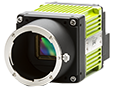
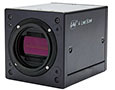
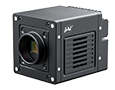
JAI’s Wave Series includes single-sensor SWIR cameras in both area scan and line scan configurations.

The SWIR area scan cameras feature advanced sensor technology with a broad spectral response from approximately 400 nm to 1700 nm, covering both the visible and SWIR spectral ranges. This extended sensitivity enables a single camera to capture image information across VIS and SWIR wavelengths, making it suitable for applications requiring inspection beyond the capabilities of conventional visible-light cameras.

For continuous inspection applications, the SWIR line scan cameras provide high-sensitivity SWIR imaging using large 12.5 μm square pixels. The large pixel size supports excellent light sensitivity and signal-to-noise performance, while 14-bit video output with 16,384 grayscale levels enables subtle differences in materials and defects to be detected with high precision.

Multisensor SWIR and Multispectral Cameras

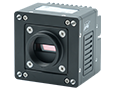
For applications requiring visible and SWIR information simultaneously, selected models in JAI’s Sweep+ Series combine multiple sensors using JAI’s prism-based imaging technology.

These multisensor line scan cameras capture red, green, and blue (RGB) image data on three separate CMOS sensors, while an additional InGaAs sensor captures SWIR information, such as the SW-4010Q-MCL model. By acquiring all spectral channels simultaneously through a common optical path, the cameras provide precisely aligned multispectral image data of moving objects.

This combination of RGB and SWIR imaging enables more comprehensive inspection and material differentiation, particularly in applications where visible appearance alone does not provide enough information for reliable detection or classification.
 

Which applications benefit from the SWIR spectral range?

Laser beam profiling

Accurate measurement of beam shape, intensity distribution, and alignment is made possible through SWIR area scan imaging. The technology also supports beam stability monitoring and safe characterization of high-power and process lasers that cannot be reliably measured with conventional visible-light cameras.

Food and Beverage

Fruit and Vegetable Sorting and Grading

SWIR imaging uses C–H and O–H absorption bands to assess material composition and moisture content, enabling detection of contamination, foreign materials, and internal quality attributes such as bruising, ripeness variation, and early mold growth.

Food and Beverage

Wafer inspection

SWIR imaging enables high-speed wafer inspection to detect hidden cracks and subsurface damage in silicon, including defects introduced during wafer dicing.

Electronics (PCB, LCD, Wafer etc)

Recycling

SWIR imaging enables reliable identification of plastics, paper, textiles, and composites on fast-moving conveyors, distinguishing visually similar polymers and detecting black or dark plastics beyond visible and NIR capabilities.

Pharmaceutical and fill level inspection

SWIR line scan imaging enables non-contact verification of liquid presence and fill levels through glass or plastic containers, using water-based absorption features to detect missing, underfilled, or inconsistent contents.

Pharmaceutical and Cosmetics

Plastic seal inspection

Line scan inspection in the short-wave infrared range enables reliable verification of heat seals in transparent or opaque plastic packaging on continuous production lines, supporting detection of seal defects such as bubbles, wrinkles, improper sealing, and closure strip irregularities.

Case studies and blogs about SWIR cameras

Blog

How SWIR inspection Supports Semiconductor Manufacturing

Semiconductors are fundamental to modern technology, forming the core of countless everyday devices, from consumer electronics and electric vehicles to industrial automation and advanced computing systems.

Read the blog
Blog

Improving food safety and quality in fruit sorting and grading with SWIR imaging

As food safety regulations tighten and quality expectations rise, producers need inspection technologies that can detect internal defects, subtle material differences, and hidden contamination at full production speed.

Read the blog

Find the best camera for your needs

Choosing the right SWIR camera depends on several factors, including your application, inspection method, object movement, required spectral information, resolution, and imaging speed. Depending on these requirements, an area scan or line scan camera, as well as a single-sensor or multi-sensor solution, may be the best fit.
JAI offers a range of SWIR imaging options to meet different industrial inspection needs. Explore our portfolio to find the camera configuration that best matches your application.

SWIR

Wave Series

Single-sensor InGaAs area scan cameras for Short Wave InfraRed (SWIR) imaging.

Explore the series
VIS, NIR, SWIR

Sweep+ Series

Multi-sensor prism-based line scan cameras combining color precision, sensitivity and NIR or SWIR multispectral options.

Explore the series

Need help – let us help you to find the perfect SWIR camera

Our camera experts are here to assist you so you can take full advantage by pairing the right JAI camera with the right lens.

Contact a JAI engineer