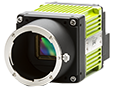
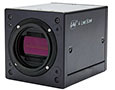
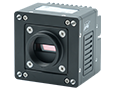
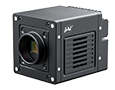
Single-sensor area scan cameras provide a versatile and cost-effective imaging solution for a wide range of industrial machine vision applications. Available for visible monochrome and color imaging, as well as ultraviolet (UV) and short-wave infrared (SWIR) imaging, they support everything from precision inspection and measurement to material analysis and classification. This page explains how single-sensor cameras work, their key advantages, when to use them, and which applications benefit most from this technology.
On this page
A single sensor area scan camera uses one imaging sensor, typically based on CMOS technology, to capture a complete two-dimensional image in a single exposure. Unlike line scan cameras, which build an image one line at a time, area scan cameras capture the entire scene at once, making them ideal for imaging stationary objects or applications where a full image can be acquired in a single shot.
Depending on the camera design, all pixels may be exposed simultaneously using a global shutter, or sequentially using a rolling shutter. Once the exposure is complete, the full image is transferred for processing, enabling fast and accurate inspection across a wide range of machine vision applications.
Single-sensor area scan cameras are available in several imaging configurations, each optimized for different inspection requirements and spectral ranges. The most common types include monochrome, color, ultraviolet (UV), and short-wave infrared (SWIR) cameras.
Monochrome area scan cameras
Monochrome area scan cameras use a single monochrome image sensor to capture grayscale images. Without color filters on the sensor, every pixel receives the full amount of available light, resulting in higher sensitivity, excellent contrast, and maximum spatial resolution. They are ideal for precision inspection, measurement, defect detection, and other applications where fine detail is more important than color information.
Find out more about JAI’s monochrome area scan cameras
Color area scan cameras
Color area scan cameras use a single image sensor with a color filter array (CFA), most commonly a Bayer pattern, where red, green, and blue filters are distributed across the pixel array. A demosaicing algorithm reconstructs the full-color image by interpolating the missing color information at each pixel.
These cameras are well suited for applications where color plays an important role, such as object classification, product verification, food inspection, and quality control.
Find out more about JAI’s single sensor color area scan cameras
Ultraviolet area scan cameras
UV area scan cameras are designed to capture ultraviolet wavelengths that are invisible to the human eye. By imaging beyond the visible spectrum, they enable enhanced detection of surface defects, coatings, fluorescence, and other features that may be difficult or impossible to detect using conventional visible-light cameras.
UV imaging is commonly used in electronics inspection, semiconductor manufacturing, life sciences, and forensic applications.
Find out more about JAI's single sensor UV area scan cameras
Short-Wave Infrared area scan cameras
SWIR (Short-Wave Infrared) area scan cameras use advanced InGaAs image sensors to capture wavelengths beyond the visible spectrum. This enables imaging of material properties that cannot be observed with standard visible-light cameras, including moisture content, contamination, internal structures, and material composition.
SWIR imaging is widely used in industrial inspection, electronics manufacturing, recycling, agriculture, pharmaceutical production, and food processing.
Find out more about JAI's single sensor SWIR area scan cameras
Single-sensor area scan cameras are ideal for applications where the entire field of view can be captured in a single image. They are commonly used to inspect stationary or intermittently moving objects, providing a complete two-dimensional image in one exposure.
Choose a single sensor area scan camera when:
Single sensor cameras are often selected over line scan cameras when the object size is manageable within a single field of view and continuous web inspection is not required.
Single sensor area scan cameras are widely used in machine vision systems for discrete part inspection, quality control, identification, and measurement tasks, where flexibility, image quality, and ease of integration are important.
Monochrome area scan cameras are ideal for applications focused on contrast, detail, and defect detection. Typical use cases include electronics inspection, semiconductor and PCB inspection, dimensional measurement, surface defect detection, and other quality control tasks where color information is not required.
Color single-sensor area scan cameras are well suited for applications where color information is essential for decision-making. Common examples include product sorting, packaging inspection, label verification, food inspection, and assembly verification, where both shape and color characteristics must be evaluated.
UV area scan cameras enable imaging at ultraviolet wavelengths, revealing features that are difficult or impossible to detect in visible light. Typical applications include fluorescence imaging, semiconductor inspection, surface contamination detection, coating inspection, forensic analysis, and life science research.
SWIR area scan cameras provide sensitivity beyond the visible spectrum, allowing inspection based on material properties rather than surface appearance alone. Common applications include moisture detection, food and agricultural inspection, semiconductor and solar cell inspection, pharmaceutical quality control, recycling and material sorting, and the detection of hidden defects beneath surface layers.
Overall, single sensor area scan cameras are the preferred choice when applications require high image quality, flexible deployment, and cost-effective imaging of stationary or intermittently moving objects. Available with monochrome, color, UV, or SWIR sensor technologies, they provide a versatile imaging platform for a wide range of industrial, scientific, and machine vision applications.
Go-X Series
CMOS area scan cameras that are compact, lightweight and attractively-priced, with added measures to prevent dust in the optical path.
Go Series
JAI´s original small CMOS area scan cameras with 2.4 or 5.1 megapixel resolutions, three interface options, plus UV models and polarized models.
Spark Series
Advanced CMOS area scan cameras delivering high resolution, high frame rates, and high image quality.
Wave Series
Single-sensor InGaAs area scan cameras for Short Wave InfraRed (SWIR) imaging.
Need help – let us help you to find the perfect single sensor area scan camera
Our camera experts are here to assist you so you can take full advantage by pairing the right JAI camera with the right lens.